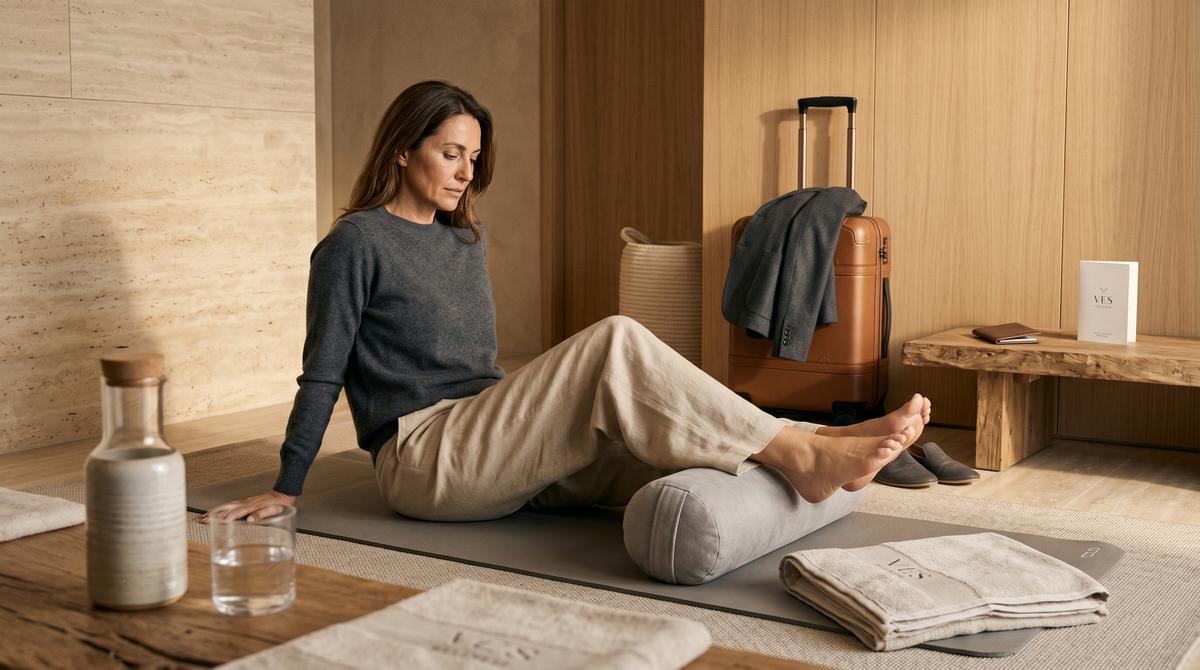

Recovery isn't a synonym for passive rest. It's an active discipline for restoring what demand — physical, mental, emotional — keeps consuming. And it has more rigour than it appears.
A word that gets misused
Recovery has become a trend. It shows up in wellbeing headlines, on spa menus and in fitness apps. The problem is that with popularity came vagueness: recovery can mean almost anything, from a massage to an ice bath, from a nap to a silent retreat.
That ambiguity does real damage to the discipline. Because recovery with method — the kind that produces measurable outcomes — follows a precise internal logic. It isn't an accumulation of techniques. It's a system.
What recovery restores
The body under pressure builds a deficit across three dimensions that aren't always treated in an integrated way.
Physical: muscular tension, subclinical inflammation, a build-up of metabolites, deteriorating sleep quality. A body that doesn't recover well between effort cycles performs less, gets injured more and ages faster at the cellular level.
Mental: cognitive fatigue, information overload, difficulty sustaining deep attention, weakened working memory. A mind operating without real recovery doesn't collapse all at once — it degrades slowly, and the person rarely notices until the deficit is significant.
Energetic: the depletion of reserves that are neither strictly muscular nor cognitive, but belong to the autonomic nervous system. It's what is popularly called burnout, and technically a dysfunction of the sympathetic–parasympathetic axis that needs time and specific conditions to reverse.
Method, not a list of services
A recovery programme with method starts from a reading of the person's real state — not a medical questionnaire, but a reading of their needs in that moment — and proposes a coherent sequence of interventions.
The sequence matters as much as the interventions. Cold before heat produces a different effect from heat before cold. Breathing before movement activates a different system from movement before breathing. Rest after sensory stimulation reaches a depth that can't be achieved without that preparation.
That's what makes recovery with method produce results where a collection of well-meaning services does not.
Why it matters now
Because the pressure on bodies and minds isn't going to ease. Because schedules aren't going to simplify. Because the profile of person who needs real recovery — executives, frequent travellers, athletes, people in high-demand phases of life — is precisely the profile that spends the least time recovering well.
Recovery wellness isn't a luxury for those with time. It's the tool that lets those without time keep performing, deciding and living with quality.